A Game of Thrones: Board Game
- 3.3
- Rating
- 10.00K
- Installs
- $8.99
- Price
 Analysis by App-foxy
I went into A Game of Thrones: Board Game expecting a digital version of a familiar political board game, and that is exactly where its appeal lies: this is not a relaxed pastime about collecting points in isolation. It puts me in charge of a House, asks me to read the intentions of other players, and makes every promise feel temporary. The result is a tense strategy experience for people who enjoy negotiation, calculated betrayal, and the uncomfortable moment when a good plan depends on someone else keeping their word.
Developed by Twin Sails Interactive, this board game is aimed at players who want a serious competitive session rather than a quick distraction. I found that its strongest moments come from the decisions around the battles, not simply from the battles themselves. Choosing whom to pressure, when to cooperate, and how much information to reveal creates the real drama. If you enjoy a game night where conversation matters as much as the board, this adaptation deserves attention.
What the purchase gives you and where it fits
The game is listed at $8.99, with in-app purchases priced at $4.49 per item. That makes the initial decision fairly straightforward: you are paying for a premium board-game experience, while the additional purchase structure deserves a closer look before spending more. I would not treat the extra items as an automatic requirement. For me, the sensible approach is to begin with the main purchase, learn how the game feels, and only then decide whether anything else adds enough value to justify another payment.
You May Also Like

 Blood Strike: 2.5 Anniversary
Blood Strike’s Loadouts Turn Every Drop Into a Tactical Gamble
A close look at Blood Strike’s custom loadouts: how fast access to signature weapons reshapes its battle royale rhythm, rewards preparation, and narrows the gap between fights.

 Pandora - Music & Podcasts
Pandora’s Music Is Easy to Start, but Harder to Recover
Pandora’s strength is its low-effort path from a seed to a station. Its weak spot is how much confidence it asks you to place in connection, setup, and quiet recovery.

 8 Ball Pool
 Is Built on Rivalries, Rematches, and Routine
A close look at the rivalries, rematches, shared routines, and unanswered safety questions that turn a quick pool match into a persistent mobile community.

 Samsung Music
’s Quiet Strength Is Playing What You Already Own
Its reach comes less from spectacle than from dependable access to a personal library. That simplicity is both the app’s strongest retention engine and its ceiling.

 AccuWeather: Weather Radar
AccuWeather Review: A Quick, Clear Forecast for Everyday Decisions
For everyday plans, the best forecast is the one you can understand quickly. AccuWeather makes rain timing, radar, and local conditions easy to act on, with a few trade-offs.

 Hill Climb Racing
Why Hill Climb Racing Still Turns Crashes Into One More Run
A tiny car, a bumpy hill and one more upgrade: Hill Climb Racing keeps resurfacing because its simple chaos makes every near-miss feel personal.
More From Our News Desk



The age rating is Everyone 10+, which fits the tone of political conflict and fantasy warfare without making it feel like an adult-only game. The original release was on Apr 6, 2021, and the current version is 1.1.3. It supports Android 7.0 or later, so compatibility is relatively broad for players using older devices. On Android, it has passed 10K+ installs and holds a 3.3 average from 456 ratings, with 60 written reviews. Those figures suggest a real but fairly modest player base, so I would approach it as a specialized strategy title rather than a huge online community game.
That audience size matters because a negotiation-heavy board game is most enjoyable when I can find opponents who understand its rhythm. A small community can be perfectly adequate if I already have friends interested in the setting, but it may be less convenient if I expect instant matchmaking at any hour. I would particularly recommend arranging a regular group rather than buying it solely for spontaneous sessions.
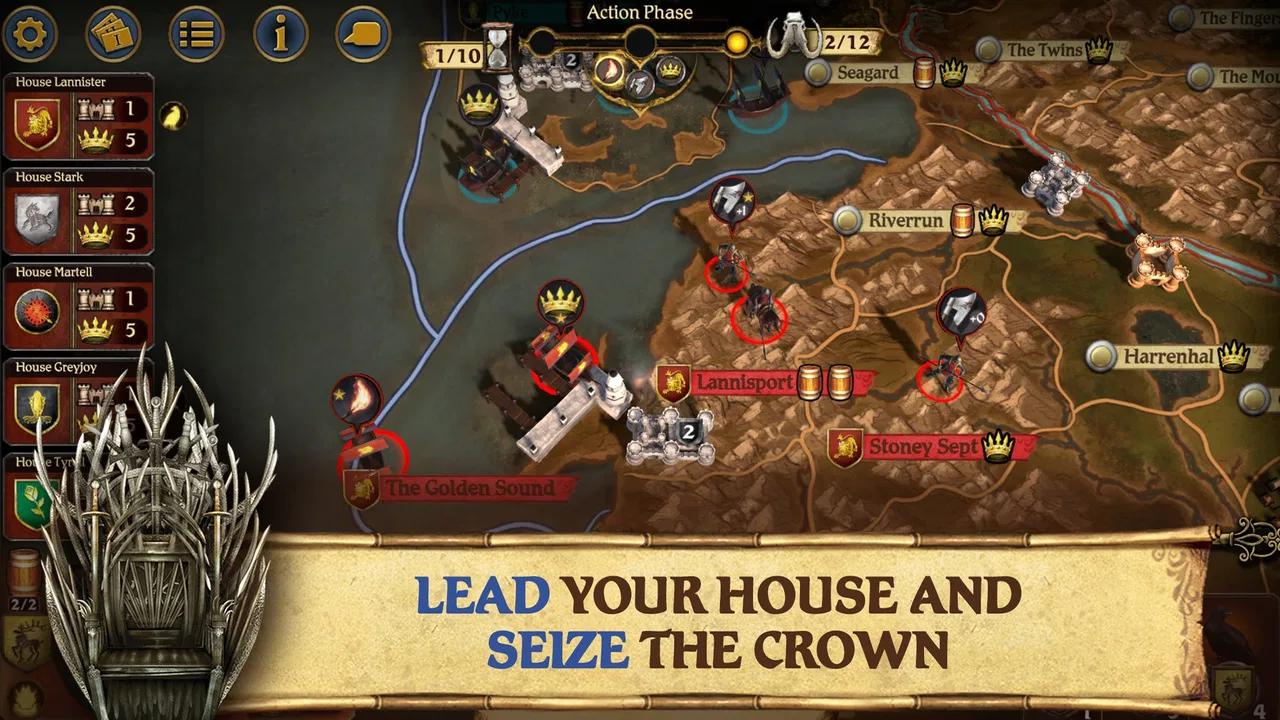
The store summary describes the central fantasy clearly: lead a House, scheme, betray, and fight for the Iron Throne. In practice, I read that less as a promise of constant action and more as a warning about the game’s priorities. It rewards attention, patience, and social judgment. Someone looking for a simple mobile board game to play in short bursts may find the political layer demanding, especially when a single careless commitment can affect the rest of a session.
Why the political layer makes each turn matter
My favorite part is the pressure created by limited trust. When I speak with another player, the conversation is not just decoration around the rules. It becomes part of the strategy. A temporary agreement can protect one border while I focus elsewhere, but it can also give the other player time to strengthen a position. That trade-off makes even a quiet turn meaningful.
A useful habit is to separate what I need immediately from what I want eventually. If I promise support because it solves a short-term problem, I should already consider what that promise allows the other House to do next. This sounds obvious, but the game makes it easy to become focused on the nearest threat. The best decisions often come from asking which opponent benefits most from my current plan, not merely which opponent is attacking me.
The game also works best when I accept that not every setback can be repaired at once. I sometimes prefer to stabilize one area instead of responding dramatically everywhere. That approach reduces the chance of spreading my forces too thin and gives me a clearer idea of which conflict actually decides my position. Players who chase every opportunity may create a memorable turn, but they can also make themselves vulnerable to a quieter rival.
That is one of the less obvious lessons here: information is a resource even when it is not represented by a number on the board. Revealing too much about my intended target can unite other players against me. Staying silent, meanwhile, can make cooperation harder. I get better results when I communicate enough to shape expectations without explaining my entire plan.
Progress feels more like changing leverage than leveling up
This is not the sort of game where I expect a character to become permanently stronger through repeated play. The progress is in my understanding of the board, the Houses, and the personalities around the table. A new player may see a promising route and miss the political cost attached to it. After several sessions, I become more aware that a move can be strategically sound and still be dangerous because it changes how everyone views me.
That makes the learning curve unusual for mobile gaming. I do not improve by simply memorizing an efficient sequence. I improve by recognizing patterns: which conflicts are distractions, when a temporary alliance has served its purpose, and how to avoid appearing like the obvious leader too early. The game rewards flexible thinking more than a fixed opening.
For a practical everyday scenario, imagine a group of friends meeting after work with enough time for a focused game night. One player wants to expand quickly, another prefers to defend and wait, and a third tries to keep both sides talking. The most enjoyable session is not necessarily the one with the most battles. It is the one where the table keeps reassessing who is trustworthy. That makes this a better fit for a planned evening than for a five-minute commute.
I would also set expectations before starting. If one person treats every agreement as binding while everyone else treats negotiation as temporary, the session can feel unfair even when the rules are working as intended. Agreeing that deals are part of the contest, and that betrayal is possible, helps prevent arguments that are really about different ideas of sportsmanship.
Fairness depends heavily on the people at the table
The competitive balance is not only about the digital implementation. It is also about how players use information and how willing they are to coordinate against a leader. A player who becomes the center of attention can be punished by several opponents, while a quieter player may build strength without attracting the same resistance. That creates a natural tension between making progress and looking too successful.
I appreciate that this gives losing players meaningful choices. Even when I am not in the best position, I can still influence who gains ground and decide which deal is worth accepting. That is more satisfying than a game where falling behind turns the rest of the session into an automatic wait for the ending.
There is a trade-off, though. A negotiation game can feel less predictable than a purely tactical board game. If I prefer competition where the winner is determined mainly by visible calculations, this may seem too dependent on persuasion and table politics. A player who is especially confident or experienced at negotiation can shape the mood of the whole session, which may discourage quieter participants.
My advice is to treat promises as tools, not guarantees. I should never commit a critical part of my plan on the assumption that another House must help me. A deal is valuable because it changes incentives, not because it removes risk. Keeping a fallback position is one of the most important ways to make the competition feel fair from my side.
The spending question also belongs here. The main price is clear, and the additional items are clearly priced at $4.49 each. I can therefore judge the entry cost without pretending that every optional purchase is necessary. I would be cautious about spending more before understanding what those items contribute to my experience. The fairest personal rule is simple: buy only when I can identify a specific improvement I want, rather than assuming extra content will solve a strategic problem or make opponents easier to beat.
What remains uncertain before I recommend it broadly
The rating of 3.3 is not a reason to dismiss the game, but it does tell me to keep expectations measured. The written feedback count is limited compared with the number of ratings, so I would not use the public score as a complete description of the experience. For a niche board-game adaptation, the important question is whether its style matches my preferences. A lower average can reflect frustration with the learning curve just as easily as it can reflect technical or design concerns.
I would also think carefully about the community scale. With 10K+ installs, this is not positioned like a mass-market mobile title. That can be a benefit for someone who wants a focused game with a particular identity, but it makes the purchase less attractive to someone who expects a constantly busy online environment. If my priority is a large pool of casual opponents, a more widely played digital board game may be the safer choice.
Another practical unknown for me is how much of the enjoyment will come from the specific group I play with. The game’s central tension relies on negotiation, so the same rules can feel brilliant with thoughtful opponents and exhausting with players who refuse to communicate or take every betrayal personally. I would be more confident recommending it to a group that already enjoys competitive tabletop games than to a family seeking a universally gentle introduction to board gaming.
The current version is 1.1.3, and the minimum Android requirement is 7.0. Those details make it accessible to a range of devices, but they do not by themselves answer whether my particular phone will feel comfortable during extended sessions. I would check available storage and general device performance before purchasing, especially if I plan to play on older hardware. That is ordinary preparation rather than a criticism, but it can prevent frustration with any strategy game that demands sustained attention.
I would also avoid confusing the setting with a guarantee that the game will deliver a story-driven adventure. Its appeal, as I experienced it, is the contest between players and the consequences of their choices. If I want a guided narrative with a fixed hero and a clear sequence of dramatic scenes, another type of game would suit me better. Here, the memorable story is the one created by the table’s decisions.
Who should play it, and who should choose something else
I would recommend it to fans of political board games, players who enjoy hidden intentions, and groups that like discussing a move before making it. It is especially suitable for people who see betrayal as a strategic possibility rather than a personal insult. The fantasy setting helps give the conflict a strong identity, but the real attraction is the shifting balance between cooperation and competition.
I would skip it if I want a quick, low-commitment mobile game, a solo experience built around predictable progression, or a competition where luck and social persuasion play only a minor role. I would also hesitate if I dislike games that can leave me recovering from an earlier mistake for a long time. This is not a title I would open casually while waiting in a queue and expect to understand immediately.
Compared with simpler digital board games, this one asks more from the group. A traditional puzzle-style alternative may be better when I want a clean personal challenge without negotiation. A lighter party game may be better when the goal is laughter and rapid rounds. A larger online strategy game may be preferable if finding opponents quickly matters most. This adaptation earns its place when I specifically want a concentrated contest of alliances, pressure, and timing.
One tip I found valuable is to watch the player who appears least threatening. The obvious aggressor often attracts defensive attention, while a cautious House can quietly become the deciding force. I also try not to spend every turn repairing my public image. Sometimes a clear, limited betrayal is easier for the table to understand than a series of vague promises that eventually leave everyone suspicious.
Another useful approach is to define a personal stopping point for negotiations. Talking can be powerful, but endless discussion may drain the energy of the session and make every decision feel less important. I get more enjoyment when I gather enough information, choose a plan, and accept that the result will contain some uncertainty. That balance keeps the political play sharp instead of turning it into a debate with no action.
My trust verdict after weighing the experience
A Game of Thrones: Board Game is a specialized purchase, not a universal recommendation. I like it because it turns a board position into a social problem: every border has a political meaning, and every alliance carries a cost. The strongest sessions leave me thinking about why I trusted someone, not only about which battle I won.
The $8.99 entry price is easier to understand than the broader spending question. Since in-app purchases cost $4.49 per item, I would keep additional spending deliberate and separate from the basic decision to play. I would not buy it expecting optional purchases to replace learning, improve my standing automatically, or guarantee a better competitive experience. The value comes from the core contest and from having the right opponents.
My final recommendation is positive but selective. If I already have friends who enjoy serious board games and I want a digital way to stage a tense struggle for control, this is worth considering. If I need a huge player population, a short session, or a forgiving ruleset, I would choose another board-game app. For the right group, the friction is part of the appeal: the game makes trust useful, betrayal dangerous, and every decision feel connected to the larger fight.
FAQs for A Game of Thrones: Board Game
01What is A Game of Thrones: Board Game?
A Game of Thrones: Board Game is a digital adaptation of the strategy board game based on George R. R. Martin’s fantasy world. Players control major Westerosi Houses, compete for territory, gather influence, and negotiate alliances while attempting to claim the Iron Throne. It is designed for strategic, competitive play rather than a quick, casual gaming session.
02How does the gameplay work?
Each match combines territory control, secret order placement, diplomacy, resource management, and battles. Players secretly assign orders to armies and fleets, then resolve actions according to the game’s rules and initiative systems. Success depends on planning several turns ahead, reading opponents’ intentions, and knowing when to negotiate or break an alliance. The experience can feel complex at first, especially for newcomers.
03Can I play A Game of Thrones: Board Game alone or with other players?
The game is primarily intended for multiplayer matches, where players compete against friends or other opponents while controlling different Houses. Depending on the version and available modes, you may also be able to play against computer-controlled opponents or practice certain mechanics offline. Before downloading, check the current edition’s supported modes, since features and online availability can vary between platforms.
04Is A Game of Thrones: Board Game suitable for beginners?
It can be enjoyed by beginners, but it is not an especially simple strategy game. New players must learn several systems, including order tokens, combat resolution, influence tracks, supply limits, and diplomacy. The tutorial or rule explanations can help, yet the first few matches may feel overwhelming. Players familiar with complex board games will generally understand its structure more quickly.
05Does the game require an internet connection or include in-app purchases?
Online multiplayer and some connected features generally require a stable internet connection, while offline play may depend on the specific mobile version and selected mode. Availability of expansions, cosmetic content, or other purchases can also differ between Android and iOS releases. It is advisable to review the store listing for the latest requirements, pricing, supported devices, and any in-app purchase information before installing.
Pros
- Faithfully captures the political tension of the TV series and novels.
- Strong strategic depth with alliances
- betrayals
- and shifting power.
- Asymmetric houses make each playthrough feel meaningfully different.
- Diplomatic negotiations add memorable player interaction beyond combat.
- High replay value thanks to variable objectives and unpredictable events.
Cons
- Rules can feel overwhelming for players unfamiliar with strategy board games.
- Games may take a long time
- especially with a full group of players.
- Heavy reliance on negotiation can frustrate players who prefer direct tactics.
- The interface may feel dated compared with newer digital board games.
- A poor early decision can leave a player struggling for the rest of the game.

A Game of Thrones: Board Game
Gallery